

Community Spotlight: William Hobbayne Centre
Sitting at the corner of St Dunstan’s Road, Ealing (where it meets Lower Boston Road) the William Hobbayne Centre belongs to the William Hobbayne Charity and is a space for local groups to meet, including BEfriend. But the Centre has a long and interesting history!
At BEfriend, we are very familiar with the Centre, we hold our monthly Team Meetings in the extension and host tea parties and other events (such as BEfriend’s 30th Birthday Party) in the main hall.
The Centre is just past the triangular junction of Boston Road and Lower Boston Road and is almost centrally positioned between the local landmarks of Elthorne Park, Hanwell Cemetery and Ealing Hospital.
Past Lives
A visitor to the main hall might wonder why there are curious messages and images to be seen. For example there is an unmissable sign painted across a beam inside that says “Go for souls and go for the worst”.
The history of the building becomes clearer when we discover that this is a quote attributed to William Booth, the founder of The Salvation Army.
The hall was formerly a Salvation Army Citadel and there is also a small stained glass window that confirms this.
It was only after being purchased by the William Hobbayne Charity in 2002 that the Centre was re-opened as a community resource, where groups including Ealing Association for the Blind, the Women’s Institute and our own BEfriend meet.
The quote refers to Booth’s intention to direct his efforts towards the homeless, the addicted, the impoverished, and those considered in the Victorian mind-set to be “beyond help” or “the worst” of society. He believed these individuals were most in need of compassion, practical assistance, and the chance for redemption.
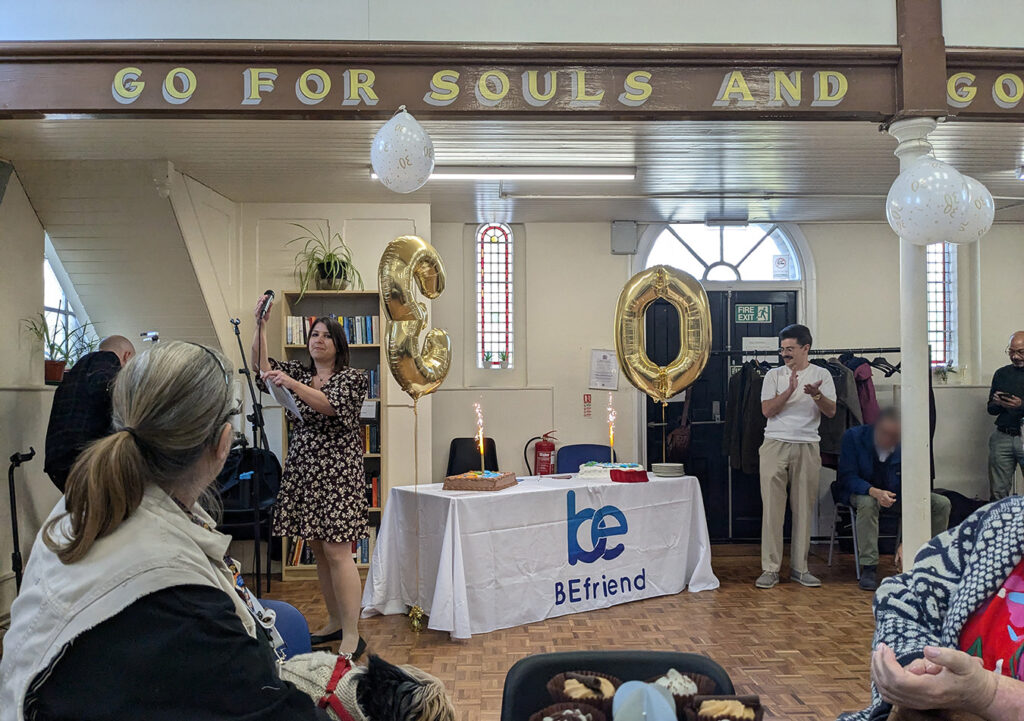
The BEfriend 30th Birthday celebration (part of the quote from William Booth can be seen).
The William Hobbayne Charity itself has a fascinating history too, somewhat shrouded in mystery due to the fact that it stretches back more than 500 years.
It was in 1459 that William Hobbayne donated a house and 22 acres of land to be used for the poor and needy of the parish of Hanwell.
In 1484 this land became the basis of the Charity and although little is known about the following two centuries, in 1773 the Charity started to help the poor with food, clothing, inoculations against small pox and apprenticeships, and in 1878 it began to be regulated by a Scheme of the Charity Commissioners.
You can find out a lot more about the Charity and it’s history at their website: https://www.williamhobbaynecharity.co.uk/

